The manufacturing industry is often seen as synonymous with being wasteful and polluting; type “polluting” or “environmental problems” into Google Image Search and you get images of smoke-emitting factories, usually offsetting an image of a green field with a windmill on it.
Is the label unfair? Well in 2012 the UK commercial and industrial sectors produced approximately 48 million tonnes of waste, which is a hard figure to visualise. Some waste streams are difficult to process and have to be burnt for energy recovery or sadly can only be disposed of in landfill sites. This isn’t ideal but it is encouraging to know that these wastes are at the very least being processed and controlled, with strict regulation on the release of wastes to the environment and of hazardous wastes into landfill.
In terms of packaging waste companies have to be proactive and move away from disposal and energy recovery routes with a greater focus on recycling. Government targets set out in 2012 declared that certain businesses must meet targets for the recycling of different packaging materials, such as paper, card, plastic and steel amongst others. The target for paper and card for example is 69.5%, with a range of ever increasing values for the other materials. In 2012 the UK recycling rate for packaging waste was 61.4%, slightly less than the 64.6% EU-27 average, obviously a figure that the government wants to see improve.
Waste is a big deal at Grotech. We handle a lot of packaging from incoming raw materials, which can easily be overlooked. As an example, we can consider the creation and filling of a fertiliser product, which is a pretty standard job at Grotech.
So… we are to make 10,000 litres of a fertiliser product and we are going to pack it into one litre bottles to be sold in shops. Firstly what raw materials are we going to be getting in? We may get the solid material that make up the fertiliser on pallets; each pallet may contain 50 × 25kg polythene sacks of our solid, with the whole pallet also wrapped in a polythene tarp. There may be other ingredients such as a liquid fertiliser solution; we may receive this in a couple of 1,000 litre IBCs (industrial bulk container). Then comes the bottles that the product will be packed into; making a one litre product we will need more than 10,000 bottles, these will also come on wooden pallets, often several layers high separated by corrugated cardboard with the whole thing again wrapped in a polythene tarp. We will also receive labels for these bottles, which will most likely come as rolls, packed into cardboard boxes, with several stacked onto a pallet.
We make our product, pack it into the one litre bottles, box and palletise them then ship them off to our hopefully happy customer with the promise of further orders to come. So what are we left with? Well, we have possibly the two now empty IBCs, several empty bags that held the solid fertiliser, dozens of pieces of rectangular cardboard along with the boxes that held the labels, the label backing paper plus inner cores, several pallets and lots of pieces of polythene sheeting. In addition there may have been bottles that leaked or we didn’t use for various reasons, these will also contribute to the overall packaging waste.
Some things are easy; pallets we can often reuse providing that they aren’t damaged, spare boxes are always handy and often miscellaneous boxes will find a use somewhere in the factory. A job like the one described will produce a fair volume of packaging waste, which has to go somewhere.
The European Waste Hierarchy would encourage us towards preventing any waste at all; sadly this is beyond our control. But minimising the amount of waste we generate is always a worthy goal to aim towards and this can be achieved through increased efficiency on our part – perhaps by rejecting fewer bottles or buying in bulk to reduce the amount of packaging received (i.e. a tonne of our solid raw material in one huge FIBC rather than 50 small sacks). Reuse is often a good option; using the card sheets for our own stacking operations or cleaning out the empty IBCs for reuse in appropriate situations.
These options are the most ideal for us but sadly only ever account for a small portion of the packaging waste that we generate. Like many companies in our industry, at Grotech we pay for the disposal of non-hazardous wastes, and our skip has a content weight limit. Additional costs are incurred when we reach this weight limit, so this provides us with yet more incentive to avoid filling the skip and turn to recycling.
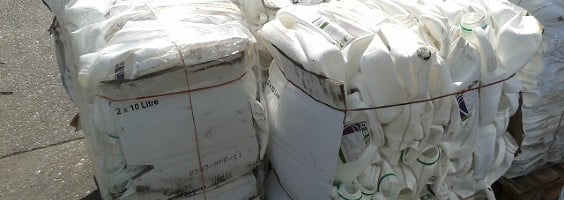
The bottles and plastic sheeting are HDPE (high density polyethylene), which is a widely recycled material, cardboard is also widely recycled. We stack and/or bale these materials and place them onto spare pallets which can be taken away by recycling contractors, often without charge or even better – sometimes for a small amount of money! It is important to ensure that the contractors are reputable and have the correct licences, but as a competitive industry there are plenty of good businesses out there providing this service. Figures vary depending on the time of year but we produce around a tonne each of card and plastic waste per month. Without the recycling option we’d be paying huge sums for waste disposal. By mass, Grotech recycles over 90% of packaging waste, a figure that we are immensely proud of.
What’s next for us? Well there are always improvements that can be made. Currently we don’t recycle the siliconised backing paper or card cores. Compared to the other waste streams these don’t amount to much but over the course of years they will add up. We are currently investigating ways to recycle these components and have found a recycling contractor who is willing to take them for us if we can package them up in a certain way – which for us will be the logistical challenge.
At the other end of our packaging waste management responsibilities is domestic waste. For example Grotech goes through a lot of milk to make coffee and our staff bring in a lot of packed lunches and take away boxes, generating a fair amount of packaging waste. I’m pleased to say that recently we have taken steps to ensure that many of these materials are segregated and recycled, such as milk bottles and paper waste. Staff education is also very important to ensure that the work-force is on-side and so will help us in this process. We have a few more hurdles to jump but in this area we are definitely heading in the right direction.
It is my hope to be able to write another blog in a year’s time and be able to say that we prevent, minimise, reuse and recycle 100% of all our packaging waste, I see that as a worthwhile and achievable goal – watch this space!